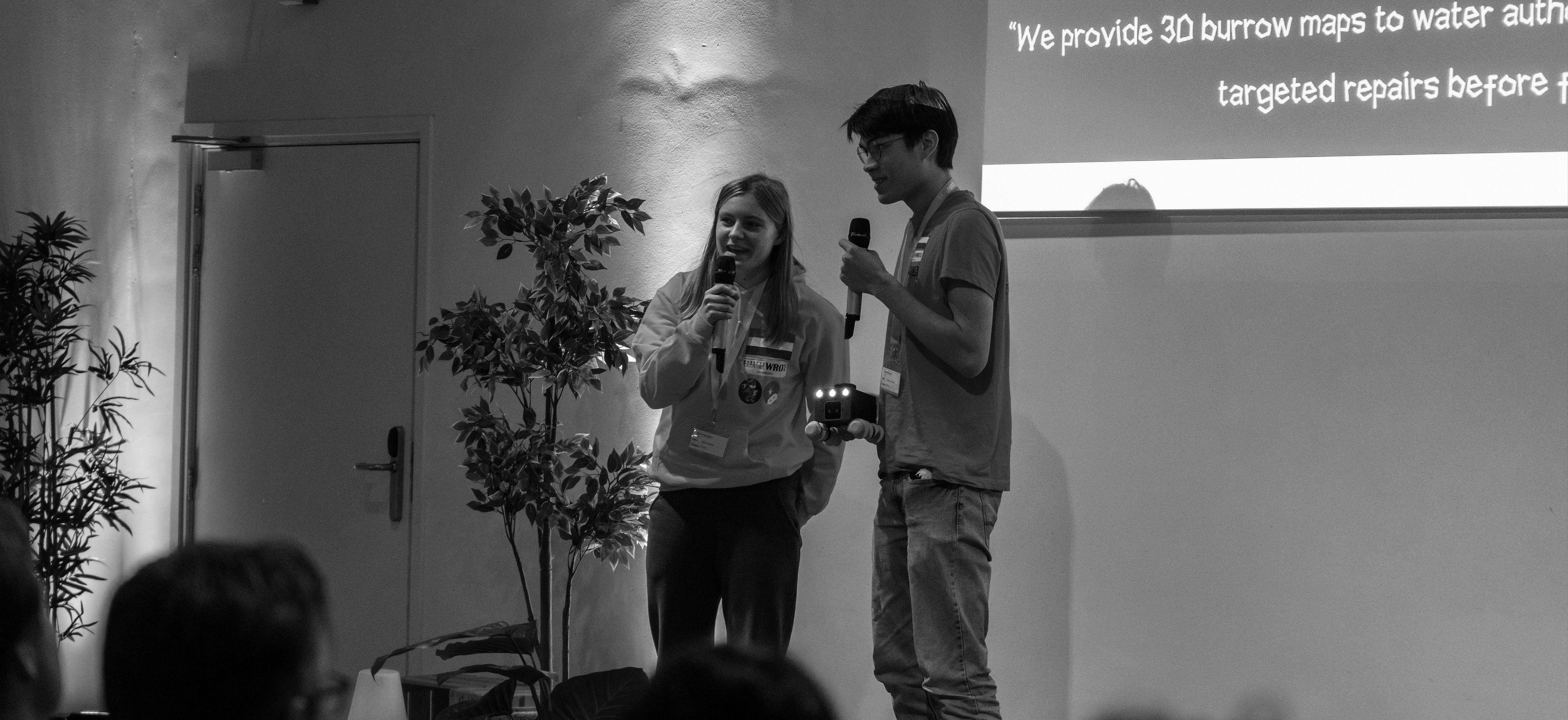
What started as a robotics competition entry has grown into a venture that is redefining how we inspect underground infrastructure. This is the BTScout story.
A Beaver Burrow and a Lego Robot
It started at a robotics competition. Kenley van Rossen was looking for a new challenge and pulled in Karina Kovalska as his teammate. The theme: natural disasters, and how to prevent or repair damage. For two students from the Netherlands, flooding seemed like the obvious angle. But when they started reaching out to experts, the response surprised them.
"We actually have a problem with beavers," someone at Deltares told them.
Beavers had been successfully reintroduced across Europe, and while that was good news for biodiversity, it was proving costly for critical infrastructure. Their burrows were appearing under train tracks, roads and flood defences, and nobody had a reliable way to inspect them, partly because of the beaver's protected status, and partly because there was simply no technology to see what was happening underground.
Kenley and Karina built their first robot out of Lego and drove it into an actual beaver burrow. "We thought, how hard can it be?" Kenley recalls. "Then we saw a beaver burrow in real life. That was very interesting."
They won the national competition, then the international finals in Turkey. And somewhere along the way, people started asking a different question: have you thought about turning this into a real company?
From Competition to Company
After winning the BK-Launch At-Launch Award, BTScout hit the ground running. They pushed hard to build partnerships, secure funding and get their robot into the field. That effort paid off. Major parties in water management and rail infrastructure took notice, and what started as conversations quickly turned into concrete pilot agreements. Parties like ProRail, STOWA and Rijkswaterstaat came on board to support and fund the first real-world tests. Through ProRail, BTScout also got in touch with Deutsche Bahn, where interest in their technology has been strong.
The BK-Launch award money went towards two things. First, developing a more advanced robot: a new prototype with a depth camera for accurate underground mapping, an infrared camera to detect whether a beaver is actually present, and a custom circuit board replacing the tangle of cables that held earlier versions together. Second, professionalising their safety equipment for actual fieldwork. Working near rivers with a current, in all weather, with sensitive electronics, requires proper gear. Dry suits, weather protection, safety equipment. The unglamorous but essential side of turning a prototype into something you can actually deploy.
A Robot That Keeps Evolving
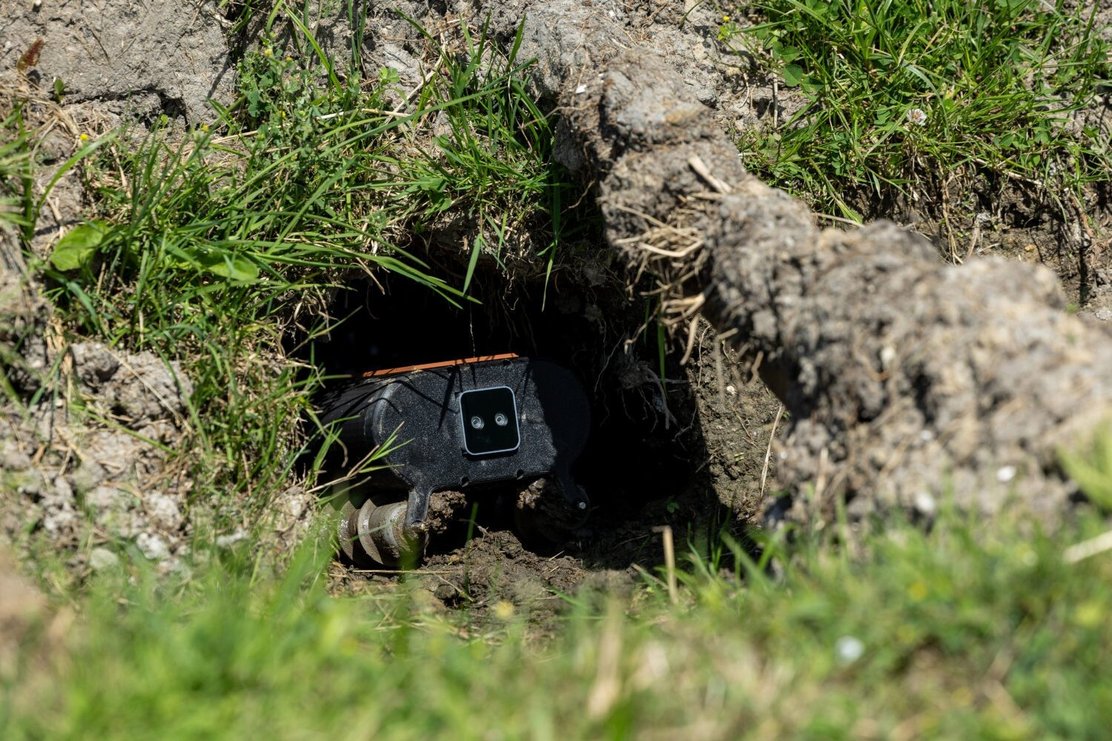
The robot that goes into burrows today looks nothing like the Lego prototype. It no longer runs on wheels, carries multiple sensors and has been steadily refined to extend battery life, improve stability and map underground spaces as accurately as possible.
The biggest remaining challenge is communication. Underground, there is no GPS signal and no reliable way to know exactly where the robot is at all times. BTScout is currently testing solutions that would allow them to communicate with the robot below ground and track its position more precisely. Going underwater is the next frontier. Everything in dry burrows now works well. Getting the robot to operate reliably in submerged burrows is what the coming pilots are designed to prove.
This summer, BTScout will carry out their first real paid assignment in Limburg, inspecting a beaver burrow for a client that came to them directly. "We were really surprised," Kenley says. "They found us and came to us. That felt like a real milestone."
Bigger Than Beavers
One of the fundamental challenges in robotics is autonomous movement without GPS. Above ground, drones and robots can navigate freely. Underwater, the same applies. But underground, there is almost nothing. That is the gap BTScout has found, and it turns out to have implications far beyond beaver burrows.
When BTScout recently entered the iAsk Pitch Event, a competition focused on robotisation, automation and digitalisation in maritime infrastructure, they had not necessarily planned to participate. But they entered, and they won. They did so, because they realised they could present their technology not just as a solution to an ecological problem, but as a platform for inspecting any tunnel system: pipelines, harbour infrastructure, underground cables. The core technology is the same. The applications are much broader.
"We're starting to see ourselves more as a robotics company than an ecological one," Kenley says. Conversations with people across different industries keep opening new doors and sparking ideas about where else their technology could be used. For now, beavers and badgers remain the focus. The pilots with STOWA, Rijkswaterstaat and ProRail come first, followed by expanding the scope to badger burrows and eventually burrows with underwater entrances. But the longer-term ambition is clear: to build a significant position in underground robotics for infrastructure, a space that is, as yet, remarkably uncrowded.
Studying, Working, and Everything In Between
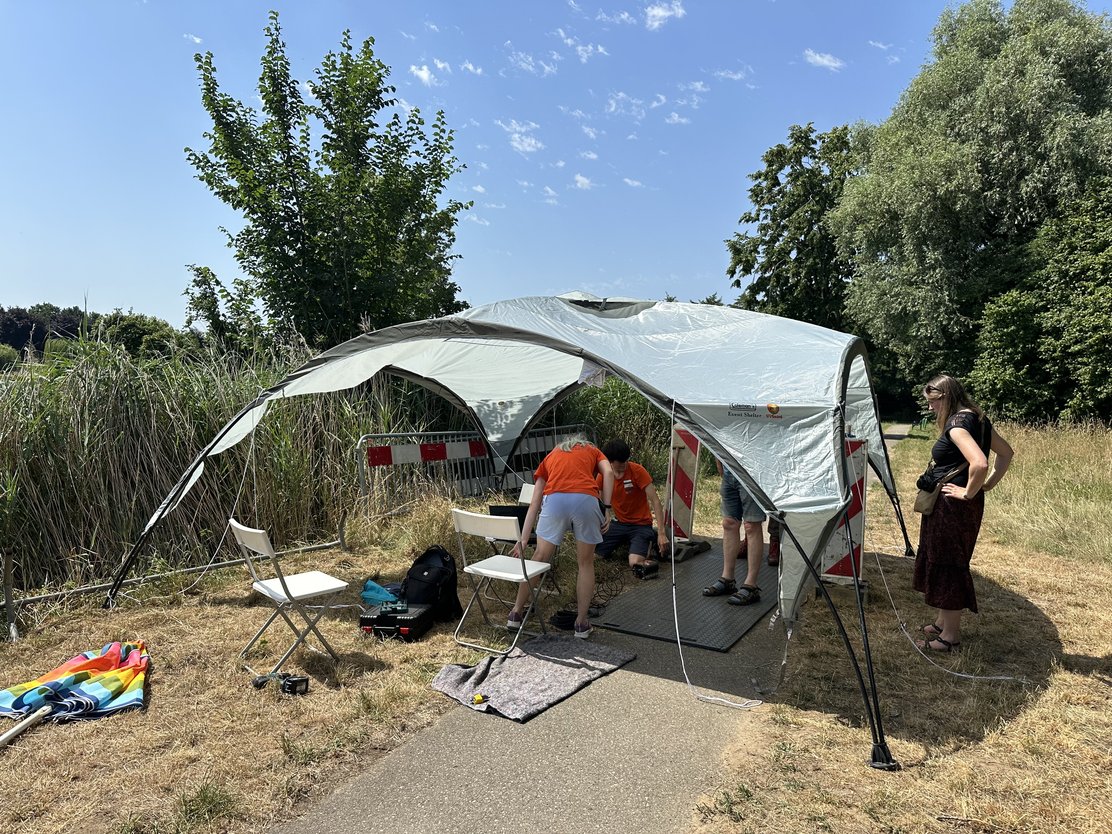
Both Kenley and Karina are both still studying next to developing their business. Kenley spends a lot of time at their workspace at RoboHouse, often into the evenings. Splitting his hours between his Aerospace Engineering studies at TU Delft and the development of their robot for BTScout. Of course it is all fun and gives them lots of energy, but it can be exhausting at times. Combining all of this asks for a lot of flexibility. Pilots happen at 9am in the middle of nowhere. That means short nights, early trains and the first bus of the day. "I'm not really a morning person," Kenley says. "But you do what needs doing."
But they can see that their hard work pays off. When we spoke, Kenley was on his way to a robotics conference in Munich, where BTScout had been invited to attend. Over the past year they have won multiple competitions and co-founder Karina was recently named one of the most talented young entrepreneurs in the Netherlands by the Financieele Dagblad, a recognition that speaks to how seriously the outside world is beginning to take BTScout.
Just Start
Asked what advice he would give to other young entrepreneurs, Kenley does not hesitate. Stop theorising and start talking to customers. Reality will always be different from whatever you planned, and the only way to find out what you actually need to build is to get out there and listen.
It is also, he notes, nearly impossible to plan three to five years ahead when you are just starting out. So it is advice that BTScout has lived by themselves as well. The company they are building today looks very different from what they imagined it to be at the start. It is better.
Are you building something in the built environment, or do you know someone who is? Applications for the BK-Launch Entrepreneurship Awards 2026 are open until 13 September. Find out more here
Category: Community